
RUMINAMTIONS
A weekly newsletter on my favourite reads - Issue #4

In Love with the Shape of You
I have been thinking a lot about shapes lately.
There are several upstanding things about shapes. Like when little kids first learn what a circle is and scribble circles on practically every surface with fat orange crayons, their parents scrubbing after them. My argument that shapes-are-upstanding-things is further substantiated by the Pythagorean theorem, the stellar role of shapes in physics, and the suave and comely arc of my vacuum cleaner.
And then there are stories.
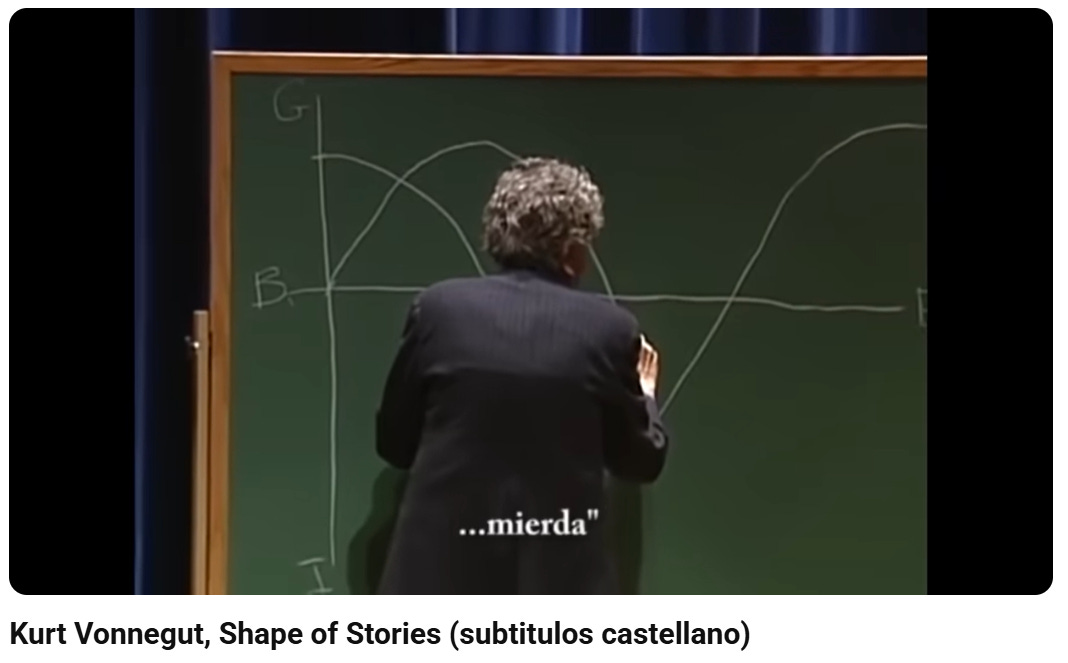
In a famous lecture, the author Kurt Vonnegut said that every story ever written has a shape. On a graph which plots the fate of the protagonist of a story over time, Vonnegut maps the ebbs and flows of how good or bad each protagonist seems to be faring. Inevitably, the peaks and troughs of practically every story ever written fall into certain shapes and patterns on a graph. Vonnegut calls these shapes by different names. In a story trajectory he calls Boy meets Girl, the protagonists live ordinary lives- and are suddenly buffeted into raptures of romance (where his graph climbs). Then drama hits and things go pear-shaped for a long time: but their story ultimately ends on a high. Conversely, Vonnegut has a storyline trajectory named Cinderella – where the life of the protagonist, Cinderella, is woefully rotten from the start (his graph plummets), and has various ebbs and flows until she ends up giddily wedded to a prince. (Apparently all women are simpering morons in dire need of rescuing by men).
Anyway, I was drinking coffee (as one does) and thinking about Vonnegut (as one does) – which is what shaped my piece for you today.

Read #1 – The Weight of Our Bodies/ Nneoma Kenure
Revisiting Vonnegut’s old lecture made me mull over how I have always loved people-watching in public places. A sizeable part of this is because human bodies have such fascinating and agreeable shapes. Whether it is that red-cheeked young professional on the subway fidgeting with their tie, the lanky vendor with a strident voice selling coconut water on the move; or practically every other human face we know and love. (Smug beauty magazines will say otherwise: that our bodies are bad shapes, we must instead squeeze them into sweaters 5 sizes too tight and plaster fairness creams on them- but they are wrong. Do the quiz on the last page about whether or not Pedro Pascal will marry you-- holding out hope is an important thing in these turbulent political times-- and then bin the damn thing).
My first read of the week was this fictional essay by Nneoma Kenure, about women at the gym. The piece made me think a lot about our bodies, how we perceive them, and the pains to which we subject them. The essay also reminded me about the idea of female hunger: how this notion that women must be pushed into certain denim sizes is a means to control us. Women have long argued that it is easier to control a population starved and obsessed with our weight than a population well-fed and primed for resistance. I reflected on this briefly in an earlier post, but good places to start when it comes to the systemic weaponisation of female hunger to control the bodies of women are probably Naomi Wolf’s The Beauty Myth and the Simone de Beauvoir’s truly seminal the Second Sex (although the latter is not solely about our bodies, it touches upon this matter). There is a lot to learn from, dissect and critique about each work – as there always is. Yet, I still find rather compelling this core premise of controlling many women - perhaps not all women as one contiguous mass (though sexists may believe otherwise) – through hunger. Heck, which South Asian woman in a big city hasn’t been told that she is too fat or too thin or too dark at some party or the other just upon entering the room? Perhaps that’s the nice thing about hitting forty. I am often tickled by comments like these and they just bounce off me (it must be all that cake I ate – wink).
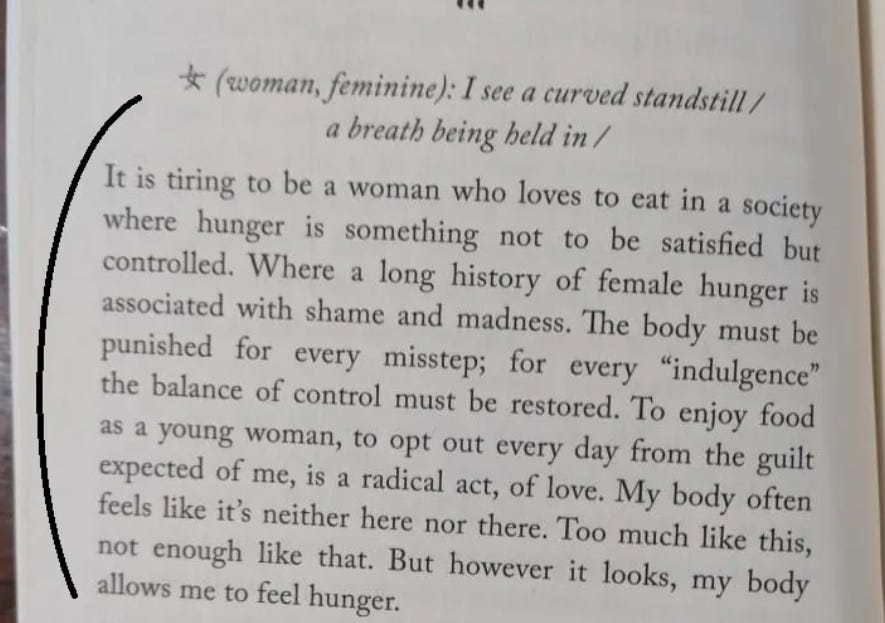
From the book Tiny Moons: A year of eating in Shanghai, by Nina Mingya Powles
Read #2 – How to get rich from peeping inside peoples’ fridges – Nicola Twilley
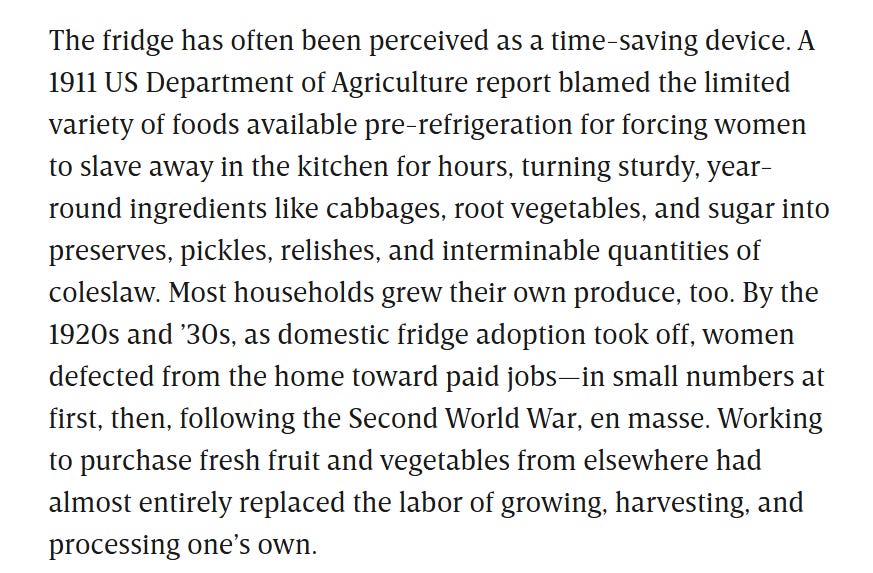
My second read of the week was an article that I read a while ago and went back to- since you all got me thinking about female hunger. The article profiles Tassos Stassopoulos, the founder of an investment firm in London, and how he learns about the future spending of families not by their stated intent (people often spend differently from their stated preferences), but by looking at the insides of their refrigerators. While there are some things to critique about the article– it is written more from an investor lens and not really a public health lens or an intersectional lens, for instance- I still found several of its insights rather fascinating. For one, it talks about how the diets of households change as they move up income brackets. The piece then goes on to link these two matters of the spread of refrigeration and dietary changes with income to larger economic trends. A sample excerpt is below.
(An aside: thank you to Thomas Fenn, India-based restaurant entrepreneur, for first sending me this article some months ago. I had interviewed Fenn about how the world of platform work is problematic not just for gig workers in the food delivery sector, but also for small businesses such as restaurants. I learned a great deal from him about how food delivery platforms can cause harm to the restaurant-scape of our cities. You can listen to our conversation here, hosted by The Migration Story).
Read #3 - The Dimensions of Data Labor: A Road Map for Researchers, Activists, and Policymakers to Empower Data Producers (A paper by Hanlin Li, Nicholas Vincent, Stevie Chancellor, Brent Hecht)
My third read of the week left me pondering the shape of the global story that is yet to come. Generative AI models have been spewed all over the news these days- and the questions being raised vary from future layoffs to plagiarising artists’ work for these models. This paper however, touches upon something that I had not thought about at all: the type of data we tend to generate simply by being online. I have screenshotted the abstract below for a better summary.
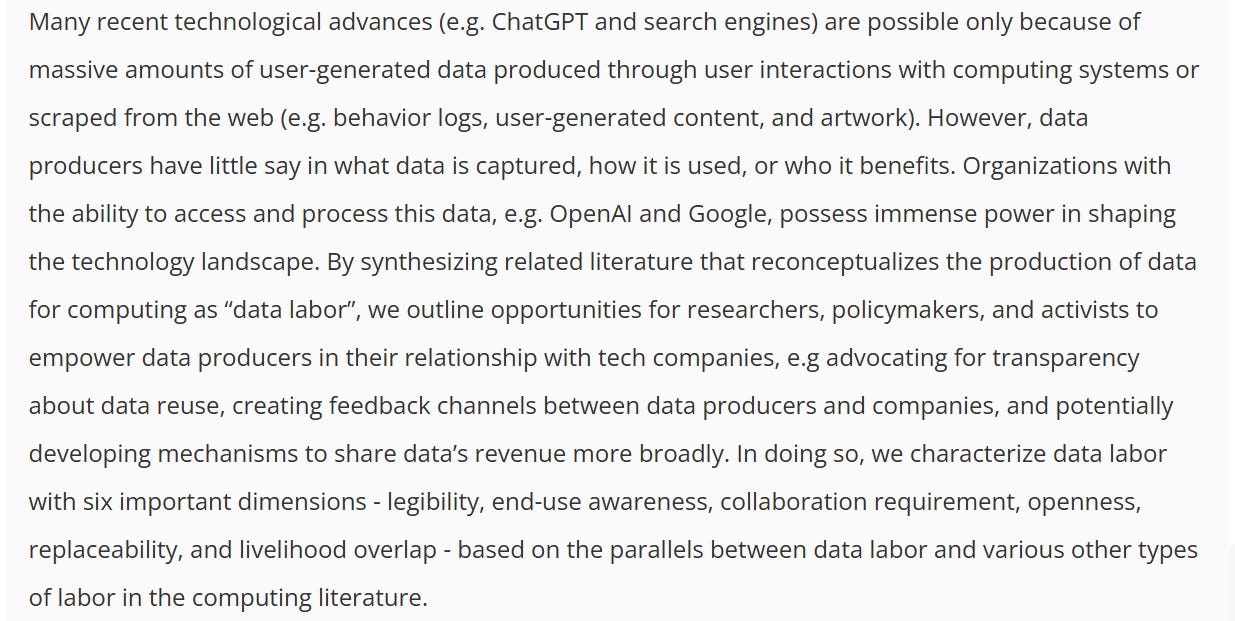
What was most compelling about this paper for me was that – I naively never thought of the data that I put into reCAPTCHA requests – when they ask you to click on several photos of a traffic signal or a motorcycle in a grid – as an attempt to also capture our behavioural data and train AI models. The paper covers a wide range of “data labour” – from posting on Reddit forums and contributing to Wikipedia articles, to invisible data labour. A must read for those of us who are worried about the murky clouds that hang over our digital horizon, and how far we have veered from the dream of the internet bringing us democracy and freedom.
Read # 4 - Happily, Cautious After (A Lockdown Memoir)- By Temitope Owolabi
My last read of the week once more had me dwelling on the shapes of things past and future. This essay, as the name suggests, is a memoir by a Nigerian-origin resident of London during the COVID-19 lockdowns. I sometimes revert to thinking about our lockdown days because – like everyone else – I do not think I have fully clocked what we all lived through, and what the many who were stolen from us did not. My memory has camera flashes of baking and exercising with loved ones and umpteen Zoom meetings, but also feelings of sinking dread- as someone would message in a panic about where we could possibly procure an oxygen tank.
I also have this dull ache for what our pre-pandemic lives once were, because some things have changed unalterably. It is something like those pulsing migraine headaches that slap blandly at your temples- except this one is in your bones. The essay captures this feeling so well:
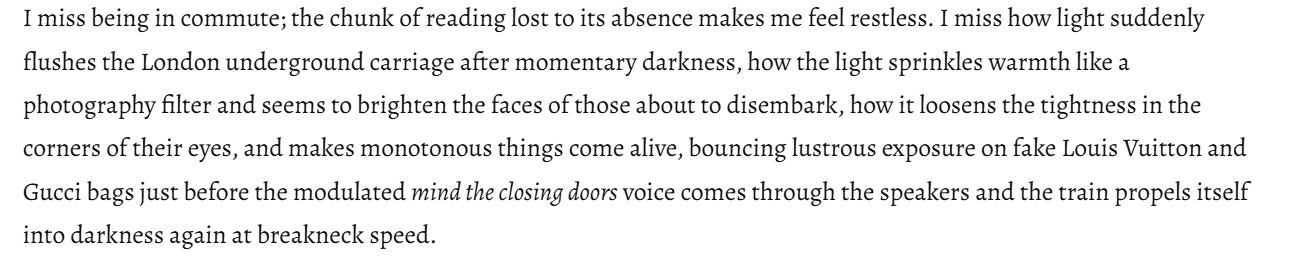
Perhaps the most striking for me was the bits in the essay where the author talks about race, making you think how even in the most dire times, a lot of people and communities cannot escape the systemic injustices heaped on them. I will not drop any spoilers here- but this essay is a must read.
The truth is, as much as I adore shapes, these days, I am sometimes taken with an ominous feeling as to the shape of things to come: much of this draws from our global political moment. Yet on the flipside, I remember my eyes swimming with tears during COVID, as I read the musician Dave Grohl’s words in an essay about live concerts during the pandemic lockdowns.
“I don’t know when it will be safe to sing arm in arm at the top of our lungs. But we will do it again, because we have to.”
My profound hope is that the graph of these tough times will plummet. We are all key protagonists of this story of our shared humanity. You, me, that red-cheeked young person on the subway, that lanky coconut vendor, even my 85-year-old neighbour who wears a huge sunhat and waves to me from his balcony every day. Perhaps the hope in the story of our shared humanity is that we do not yet know how the graph ends: so we can do all we can to shape it. And in the meanwhile, when the going gets tough, we will sing arm in arm at the top of our lungs.
The road may be winding sometimes and the traffic arduous. But turn up the volume and the drive instantly feels a little better with Dave Grohl.
Trying to see the shape as it’s being drawn around us is hard work. Anxiously reading a headline to see not just the catastrophe in it today but what it means for that shape. And plug for your interview with Thomas Fenn. It was a wonderful piece and so relevant to my work at the time.
Fantastic insights on multiple fronts. I hadn’t thought about AI labor and its implications for example. Your COVID comments had me thinking of our trip together to Kerala - tourist stragglers before the borders shut just days later !
I too want to grip the hope of a positive global shift. Keep sharing your ruminations !